

Loose leash walking training teaches your dog to walk with consistent slack in the leash without constant pulling, dragging, or tug-of-war. It is a valuable everyday skill because persistent pulling can make walks harder to manage and less enjoyable for both the dog and the person holding the leash.
This guide covers the fundamentals of teaching loose leash walking, from foundation skills and equipment selection to step-by-step practice and troubleshooting common problems. Whether you’re working with a puppy that is new to a leash or an adult dog with a long history of pulling, this guide offers practical ways to improve leash manners and make everyday walks easier to manage. It also covers situations involving distractions and reactive behavior.
The goal is to maintain a relaxed leash rather than require a strict heel position throughout the entire walk. Training timelines vary depending on the dog’s age, previous reinforcement history, level of distraction, behavior, equipment, and how consistently the owner practices. Some dogs improve quickly, while others need substantially more repetition and gradual exposure.
By the end of this guide, you’ll understand how to:
- Reduce pulling and reinforce more desirable walking behavior
- Select appropriate harnesses, leashes, and training equipment
- Follow a progressive training plan from easier environments to more distracting settings
- Troubleshoot common challenges around wildlife, other dogs, and busy environments
- Build stronger attention and leash manners that support broader obedience training
Understanding Loose Leash Walking Fundamentals
Loose leash walking is built through repetition, clear communication, and gradually increasing distractions. Beginning in an easier environment gives your dog more opportunities to understand what behavior earns reinforcement before you expect the same response on a busy sidewalk or trail.
What Constitutes Proper Leash Walking
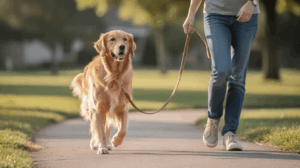
A slack leash often forms a relaxed “J” shape between the dog and handler. There should not be constant tension pulling your arm forward or continuous pressure from your dog straining against the collar or harness.
Loose leash walking does not require your dog to remain in a strict heel position or within an exact distance from your body. Your dog may walk on either side as long as the leash remains comfortably slack and you can safely manage the walk. Voluntary check-ins, such as glances or head turns toward you, can also help maintain engagement around distractions.
Clear communication, consistency, and practice are also important parts of professional dog obedience training, especially when owners want leash skills to remain dependable around real-world distractions.
Prerequisites for Successful Training
Before practicing in a highly distracting outdoor environment, it helps if your dog has a few foundation skills. Name recognition is a useful starting point because it gives you a simple way to redirect your dog’s attention during a walk.
Attention cues such as “look” or “watch me” can also help. Practice in an easy environment and reward your dog for orienting toward you before gradually adding distractions.
Recall is valuable for general safety and obedience, but your dog does not need a reliable recall before beginning loose leash walking training. More directly relevant skills include responding to their name, reorienting toward you, following simple cues, and learning how to respond calmly when they feel leash tension.
Your dog’s physical and emotional state also matters. Excitement, stress, previous pulling habits, discomfort, and environmental distractions can all affect walking behavior. Dogs also experience the environment heavily through scent, which is one reason stopping to investigate smells can be so motivating.
If your dog appears painful, has difficulty breathing, or shows another physical problem during walks, consult your veterinarian before assuming the issue is purely behavioral.
Essential Equipment and Training Setup
Equipment does not train your dog by itself, but an appropriate setup can make practice safer and easier to manage.
Choosing the Right Harness and Leash
A properly fitted harness can be a useful option for loose leash walking, particularly for puppies or dogs for whom reducing pressure on the neck is important. Equipment should fit securely without restricting normal movement, and dogs with respiratory, orthopedic, or other medical concerns may need guidance from their veterinarian.
A properly fitted front-clip harness can be useful for dogs that pull because the front attachment can help redirect forward movement and give the handler additional control. It is a management tool rather than a substitute for training. Back-clip and dual-clip harnesses can also be appropriate depending on the dog, fit, walking environment, and training goals.
For structured loose leash walking practice, a standard fixed-length leash provides a clear difference between slack and tension. Longer leashes serve a different purpose and can be useful for appropriate exploration, recall practice, or lower-structure walks in safe environments.
Retractable leashes are generally not ideal when first teaching loose leash walking because their changing length can make it harder to establish a consistent definition of slack leash behavior. A standard leash is usually easier for structured practice. Whatever equipment you use, proper fit, clear handling, and appropriate instruction are important.
Training Collar Integration
Off-Leash K9 Training Colorado includes an e-collar in several training programs, including Starter Training, Basic Obedience, and Board & Train options. The company’s FAQ states that e-collar training generally begins when a dog is at least five months old. Owners participating in a professional program should follow their trainer’s instructions for the equipment included with that program rather than applying an unverified training sequence on their own.
Owners considering professional training can review the available training programs and pricing to compare options and what each program includes.
For loose leash walking practice at home, the foundation remains clear communication and consistent reinforcement of the behavior you want. Equipment can support that process, but it does not replace proper timing, repetition, and gradual work around distractions.
Progressive Training Protocol
Systematic progression helps dogs practice loose leash walking without increasing difficulty too quickly. The following framework moves from lower-distraction environments toward more challenging situations, with practical signs you can use to decide when your dog is ready for the next step.
Foundation Skills Development
Begin in a low-distraction environment such as your home, hallway, driveway, or another quiet area.
- Name recognition: Say your dog’s name once. When they orient toward you, mark the behavior with a word such as “yes” or a clicker and reward. Practice in several short sessions rather than one long session.
- Attention cues: Introduce a cue such as “look” or “watch me” and reward brief attention. Gradually practice around mild distractions as your dog becomes more successful.
- Leash pressure response: In a low-distraction area, use gentle leash pressure and reward your dog when they move with you instead of continuing to pull against the leash.
- Threshold manners: Practice calm behavior before moving through doors, gates, or other transition points. If your dog rushes ahead, reset and try again rather than allowing pulling to move them forward.
Move outdoors when your dog can perform these foundation skills consistently in the easier environment. If focus falls apart outside, reduce the difficulty instead of forcing the dog through the distraction.
Environmental Progression
Use short, manageable training sessions and increase distractions gradually.
| Environment | Expected Challenges | Suggested Session Length | Example Success Signs |
| Indoor or hallway | Minimal distractions and adjusting to equipment | 5–10 minutes | Walks several steps with slack and responds to you |
| Front yard or driveway | New smells and mild visual distractions | 10–15 minutes | Maintains slack for short stretches and responds to name |
| Quiet neighborhood street | Cars, pedestrians, and unfamiliar surfaces | 10–15 minutes | Can reorient after mild distractions |
| Busier sidewalk or local park | Dogs, joggers, children, and stronger smells | 15–20 minutes | Passes moderate distractions with manageable focus |
| High-distraction setting | Wildlife, dogs, crowds, and novel surroundings | 15–20 minutes | Maintains workable leash behavior and frequent check-ins |
These durations are examples rather than requirements. Some dogs benefit from shorter sessions, particularly when learning in a new environment.
Teach your dog to reorient to you when entering a new space. At a trailhead, park entrance, or other unfamiliar location, give your dog a moment to notice the environment and reinforce voluntary attention toward you before moving forward.
Advance when your dog is consistently successful at the current difficulty. If leash pulling or loss of focus increases substantially, return to an easier environment or create more distance from the distraction.
Real-World Application Techniques
Once your dog understands the basic concept, several techniques can help reinforce the behavior during everyday walks.
Stop-and-wait method: Stop moving when the leash becomes tight. Wait for your dog to create slack, then mark or reward that change and continue forward. This approach is similar to the “Tree Method” described by UC Davis School of Veterinary Medicine, in which forward movement resumes after the leash relaxes. This teaches your dog that pulling does not automatically produce forward movement.
Turn-and-go: If your dog begins pulling strongly toward something, change direction and encourage the dog to move with you. Reward once they reconnect and the leash becomes slack again.
Treat placement: Deliver rewards near the position where you would like your dog to walk. If you consistently reward several feet in front of you, your dog may begin expecting reinforcement in that location.
Reinforcement progression: Reward frequently when first teaching a behavior. As your dog becomes more consistent, gradually make reinforcement less predictable while continuing to reward particularly difficult successes around distractions.
Structured sniffing: Sniffing gives dogs an important opportunity to explore their environment. Teaching a cue such as “go sniff” can help separate structured walking from periods when your dog is allowed more freedom to investigate scents. In appropriate areas, a longer leash can also provide a less structured form of enrichment while you continue reinforcing voluntary check-ins.
Continue rewarding voluntary check-ins when your dog looks toward you without being prompted. These moments indicate that your dog is paying attention to both you and the surrounding environment.
Consistency in timing, cues, and reinforcement makes the rules of the walk easier for your dog to understand.

Common Challenges and Solutions
Even dogs that understand loose leash walking in quiet areas may struggle when distractions become more difficult. Everyday walks can include wildlife, cyclists, unfamiliar dogs, crowds, traffic, and other rapidly changing distractions.
Strong Pullers and Reactive Dogs
If your dog has been pulling for months or years, the behavior may have a long reinforcement history. Pulling often continues because it has repeatedly helped the dog reach interesting smells, people, dogs, or other destinations.
Return to a lower-distraction environment and use rewards your dog finds motivating. If additional management is needed, a properly fitted front-clip harness may provide more control while you continue training. Keep enough leash to allow natural movement without giving the dog excessive room to build momentum, and reinforce calm behavior at doors, corners, and other transition points.
For dogs with reactive behavior toward other dogs or people, leash pulling may be only one part of the problem. Fear, frustration, excitement, or other emotional responses can make it difficult for a dog to respond to normal leash cues around triggers. Increasing distance, working below the dog’s reaction threshold, and seeking professional guidance can be more appropriate than repeatedly practicing close to the trigger. Program suitability should be determined individually.
High-Distraction Environments
Teach your dog to check in with you before expecting reliable walking around difficult distractions.
When approaching another dog, wildlife, or another known trigger, try to get your dog’s attention before they become intensely focused on it. Increase distance when necessary and reinforce attention while your dog is still able to respond.
If your dog becomes stiff, stares intensely, lunges, or can no longer respond to familiar cues, the situation may be too difficult at that distance. Move farther away and resume training once your dog is able to engage again.
For trail environments, practicing an emergency U-turn in easier settings can also be useful. A well-rehearsed direction change gives you a familiar response when wildlife, an approaching dog, or another unexpected situation appears.
Consistency and Handler Errors
The person holding the leash can unintentionally reinforce pulling even when they are actively trying to stop it.
Inadvertent reinforcement: If pulling repeatedly moves your dog closer to something they want, the behavior can become stronger. Try to avoid allowing tight-leash pulling to be the strategy that earns access to smells or destinations.
Inconsistent timing: Reward as close as possible to the behavior you want so your dog can make the connection between maintaining slack and earning reinforcement.
Equipment problems: Poor fit, uncomfortable equipment, or a leash that is difficult to control can interfere with training. Choose equipment that fits your dog and allows you to handle the leash safely.
Skipping foundation work: Moving directly into a highly distracting neighborhood, park, or trail before your dog understands the behavior in an easier setting can make learning unnecessarily difficult.
If progress has stalled despite consistent practice, professional guidance may help identify where communication, reinforcement, equipment, or distraction level is causing difficulty. Seek help sooner if pulling creates a safety concern or your dog also shows significant fear, reactivity, or aggression.
Dog training is an ongoing process. Puppies may change significantly as they mature, and adult dogs can temporarily struggle when routines or environments change. Continuing to practice in different settings helps maintain the behavior over time.
Loose leash walking improves through consistent practice, appropriate equipment, and gradual progression through different distraction levels. The pace is different for every dog, so focus on consistent improvement rather than trying to meet a fixed training deadline.
Start by assessing your current equipment. Choose a secure, properly fitted collar or harness and a leash that gives you comfortable control. A front-clip harness may be useful for dogs that pull strongly.
Next, practice foundation skills such as name recognition, attention, calm leash responses, and short periods of loose leash walking in an easy environment. As your dog becomes more consistent, move outdoors gradually and progress from quieter areas to more distracting environments.
Give your dog appropriate opportunities to sniff and explore in safe areas while continuing to reinforce check-ins and manageable leash behavior. Once your dog develops better leash manners, you can continue building other obedience skills such as recall, place, distraction control, and more advanced walking behaviors.
If you want professional help building better leash manners and obedience, Off-Leash K9 Training Colorado offers a free 30-minute consultation to discuss your dog’s current behavior and training goals.
Frequently Asked Questions
How long does loose leash walking training typically take?
There is no universal timeline. Progress depends on your dog’s age, previous pulling history, level of distraction, behavior, and how consistently you practice. Some dogs improve relatively quickly, while others need a longer period of gradual training.
What kind of harness is best for loose leash walking training?
A properly fitted front-clip harness can be helpful for dogs that pull because it can redirect forward movement and give the handler additional control. The best setup depends on the individual dog, fit, comfort, and training goals.
Can I use a retractable leash for loose leash walking training?
Retractable leashes are generally not the easiest option for teaching loose leash walking because their changing length makes it harder to maintain consistent leash criteria. A standard fixed-length leash usually provides clearer control during structured practice.
How do I handle my dog pulling during walks?
Stop moving when the leash tightens and allow your dog to create slack. Mark or reward the slack leash and then continue walking. Changing direction can also help redirect a dog that has become focused on moving ahead.
Is it okay to let my dog sniff during walks?
Yes. Sniffing is a natural form of exploration and enrichment for dogs. A cue such as “go sniff” can help you distinguish between structured loose leash walking and periods when your dog has more freedom to investigate the environment.
What should I do if my dog is reactive while on leash?
Reactive dogs may need additional behavior support alongside leash training. Increase distance from triggers, reinforce attention when your dog is able to respond, and seek professional guidance when reactions are difficult to manage. The appropriate training format should be determined for the individual dog.