
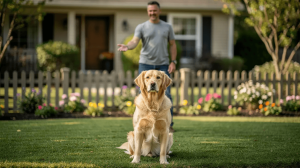
If you want to train your dog to stay in the yard, begin with structured boundary training, dependable recall, and impulse-control exercises. Whether you have a fenced backyard or an open yard, teaching a clear property boundary can improve safety. However, training should supplement—not replace—secure containment and responsible supervision.
This guide explains how to introduce a yard boundary, practice with a leash and long line, add realistic distractions, and decide when professional help may be appropriate. It also covers the limitations of electronic containment and off-leash training.
The basic process is straightforward: establish a visible boundary, guide your dog back before they cross it, reward the decision to remain in the yard, and gradually practice around controlled distractions. Progress depends on the individual dog and should never be rushed.
Off Leash K9 Training Colorado offers professional training for Colorado dog owners who want help developing recall, impulse control, and reliable everyday obedience.
What Yard Boundary Training Means
Yard boundary training teaches a dog to recognize a defined property line and remain on the permitted side unless released by the handler. The boundary might follow a sidewalk, driveway, fence line, row of flags, or another consistent visual feature.
This skill is different from a traditional stay command. A stay asks a dog to hold one position temporarily. Boundary training teaches the dog to move within an approved area without crossing its edge.
Dogs do not naturally understand property lines. They respond to their environment, previous reinforcement, and immediate motivation. A passing dog, rabbit, cyclist, or delivery driver may be more compelling than the boundary unless the dog has practiced responding under gradually increasing distractions.
Even a well-trained dog can make a mistake. Boundary awareness should therefore be treated as an additional layer of safety, not a replacement for a secure fence, leash, or attentive supervision.
Skills Your Dog Should Learn First
Boundary work is easier and safer when the dog already has several basic skills.
Reliable Recall
Your dog should respond to “come” in a quiet indoor space and in a securely enclosed outdoor area before practicing near an open property boundary.
Recall should be associated with something positive. Reward your dog for returning instead of scolding them, even if the response was slower than expected.
Sit, Down, and Place
Position commands give you practical ways to manage your dog near gates, driveways, visitors, and other high-risk areas.
A place command can be particularly useful when the garage door is open, packages are arriving, or people are entering the yard.
Leash Engagement
Your dog should be able to walk with you without constantly pulling toward the environment. Regular check-ins and responsiveness on leash make it easier to introduce a property boundary calmly.
If these foundations are not yet established, consider beginning with professional dog obedience training before attempting off-leash yard work.
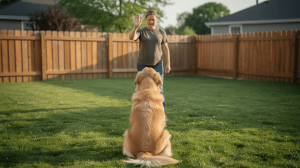
Assess Your Yard Before Training
Before beginning, inspect the physical property and identify the areas where a mistake would create the greatest risk.
Check Existing Barriers
Inspect fences, gates, and latches for gaps, loose boards, digging areas, or objects a dog could use to climb. Training cannot compensate for damaged containment.
Identify High-Risk Areas
Pay particular attention to:
- Driveway entrances
- Sidewalk edges
- Open gates
- Garage thresholds
- Areas near traffic
- Spaces where wildlife is commonly seen
- Corners where visibility is limited
If your property borders a busy road or your dog has a history of escaping, use secure physical containment rather than relying on boundary training alone.
Consider Local Rules
Leash and animal-control requirements vary by jurisdiction. Check the rules that apply to your exact address before allowing a dog off leash outside a securely enclosed area. Denver residents can begin with the city’s Animal Protection information.
Remove Outdoor Hazards
Remove accessible chemicals, toxic plants, sharp objects, and unsecured trash. Provide fresh water and weather-appropriate shade during outdoor training.
Choose Appropriate Training Equipment
Equipment should provide safety and clarity without creating unnecessary risk.
Standard Leash
Begin with a regular leash that allows you to guide the dog before they cross the property line. Early sessions should be calm and controlled.
Long Line
A properly sized long line gives your dog more room to move while allowing you to maintain physical control. Attach it to suitable, properly fitted equipment, hold it securely, and prevent it from wrapping around people, animals, or obstacles.
Do not leave a dog unattended on a long line or tie the line to an unsecured object.
Boundary Markers
Flags, cones, or temporary stakes can make an invisible property line easier to understand during the early stages. Place markers consistently and remove them gradually only after the dog demonstrates reliable awareness.
Place a Cot or Mat
A raised cot or mat provides a clear station near a gate, garage, or front porch. It can help manage the dog while visitors enter or while household members move through an open threshold.
E-Collars
An e-collar is not required to teach yard boundaries. Some professional programs use one as part of a broader training system, but suitability depends on the dog and the handler’s ability to use the equipment correctly.
Research comparing remote electronic collars with reward-based training found no evidence that electronic collars were necessary for effective recall training. Owners considering an e-collar should discuss its risks, alternatives, fit, conditioning, and timing with a qualified professional. See the published study for additional context.

How to Train Your Dog to Stay in the Yard
The safest progression begins on a standard leash, advances to a securely held long line, and adds distractions only after the dog understands the boundary.
Phase 1: Introduce the Boundary on Leash
Walk your dog slowly around the inside edge of the permitted area.
- Choose a consistent boundary cue, such as “yard” or “inside.”
- Pause when you reach the property line.
- Turn back toward the center of the yard.
- Mark and reward your dog for following you back.
- Repeat the exercise at several points around the perimeter.
Do not pull your dog repeatedly across the line and then correct them. The objective is to teach the correct choice before the dog rehearses leaving.
Use a separate release cue when you intentionally leave the property with your dog. For example, ask for a pause at the driveway, say “let’s go,” and then walk across together. This distinction helps the dog understand that crossing happens with the handler’s permission.
Keep early sessions brief enough that your dog remains attentive and successful.
Phase 2: Practice With a Long Line
Once your dog begins pausing or turning back at the boundary, continue training with a securely held long line.
Allow your dog to explore inside the permitted area while you remain close enough to manage the line safely. If the dog approaches the edge:
- Give the boundary cue.
- Call the dog back.
- Guide with the line if necessary.
- Reward promptly when the dog returns.
Introduce controlled, low-level distractions at a safe distance. Begin with distractions your dog can notice without pulling toward or crossing the boundary, then increase difficulty gradually.
Examples may include:
- A household member walking nearby
- A stationary bicycle
- A person standing on the sidewalk
- A quiet vehicle arriving
- Normal neighborhood sounds
Avoid deliberately enticing the dog across the property line. The purpose is to practice a successful response, not test the dog until they fail.
Phase 3: Increase Distance and Distractions
Continue using the long line as you gradually increase:
- The handler’s distance from the dog
- The amount of time spent in the yard
- The dog’s proximity to the boundary
- The intensity of manageable distractions
Advance only when the dog responds consistently at the current difficulty. If the dog ignores recall, pulls toward the boundary, or becomes fixated on a distraction, increase distance from the trigger and return to an easier exercise.
Phase 4: Consider Limited Off-Leash Practice
Off-leash practice should begin only in a securely enclosed area or under appropriate professional guidance. Continue using a securely held long line in an open yard until your dog responds consistently around realistic distractions.
An unfenced yard near traffic is not an appropriate place to test whether training will hold. One mistake can place the dog, motorists, pedestrians, and other animals at risk.
Even after successful training, remain present and attentive during yard time.
Teaching Boundaries at Gates and Garages
Dogs frequently escape through gates and garage doors rather than across a normal property edge. Treat these openings as separate training locations.
Ask your dog to sit, down, or go to place before opening the gate or garage. Open it only slightly at first. If the dog moves forward, close the opening and reset the exercise.
Gradually practice with a wider opening while maintaining physical control through a leash or long line. Release the dog through the threshold only when you are ready to leave together.
During deliveries, parties, yard work, or other busy activities, use an indoor room, secure crate, closed gate, or supervised place station. Management is safer than expecting a dog to maintain a difficult boundary amid uncontrolled activity.
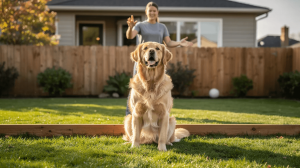
Common Yard-Training Problems
The Dog Chases Wildlife or Passing Dogs
Prey drive and social interest can overpower early boundary training.
Return to a securely held long line and work farther from the trigger. Reward the dog for noticing the distraction and then redirecting attention to you. Do not practice this situation off leash.
If wildlife activity is unusually high, move the session indoors or to a securely fenced space.
The Dog Escapes Through an Open Gate
Practice threshold control at the specific gate or garage opening. Use a leash, ask for a stationary command, and reward the dog for remaining behind the threshold.
Physical safeguards remain important. Repair gate latches, remind household members to close gates, and use self-closing hardware where appropriate.
The Dog Responds Only When Wearing Training Equipment
Practice with different ordinary walking setups while maintaining safe physical control. Reward good choices during everyday yard time, not only during formal sessions.
Do not suddenly remove all management equipment in an open area. Fade equipment gradually in a secure environment after the behavior has become consistent.
The Dog Ignores Recall Outside
Move back to an easier environment. Recall should first be dependable indoors and in fenced spaces before it is practiced near an open boundary.
Use meaningful rewards, avoid repeatedly calling when the dog is unlikely to respond, and prevent the dog from rehearsing escape behavior.
The Dog Has Already Learned to Run Away
A history of successful escapes makes leaving the yard highly reinforcing. These dogs often require stricter management and a longer training progression.
Use secure physical containment and seek professional guidance rather than repeatedly testing the dog in an open yard.
Comparing Yard-Containment Options
No single option is appropriate for every dog or property.
| Option | Main advantage | Important limitation |
| Physical fence | Creates a visible barrier and can help keep other animals or people out | Requires maintenance; dogs may dig, climb, or escape through an open gate |
| Electronic containment | May create a defined perimeter where physical fencing is unavailable | Does not keep other animals or people out and may not stop a highly motivated dog |
| Tie-out or trolley | Provides temporary physical restraint | Can create entanglement, injury, frustration, and supervision risks |
| Boundary training | Builds recall, impulse control, and communication | Cannot guarantee containment and requires continued practice and supervision |
| Fence plus training | Combines physical containment with learned behavior | Still requires maintenance, responsible supervision, and owner follow-through |
For many households, a maintained physical fence combined with obedience and boundary training provides the strongest overall safety system.
Electronic containment should not be treated as equivalent to a physical fence. It does not prevent another dog, wild animal, or person from entering the property, and some dogs may cross the boundary when highly motivated.
Special Considerations for Puppies
Puppies can begin learning simple boundaries, but their attention, recall, and impulse control are still developing.
Start with:
- Short, positive perimeter walks
- Name recognition and recall
- Waiting at doors
- Place training
- Supervised exploration on leash
- Consistent release cues
Do not expect a young puppy to make dependable decisions around traffic, wildlife, or unfamiliar dogs. Use secure containment and close supervision while foundational skills develop.
Reactive, Aggressive, or Highly Anxious Dogs
Dogs with aggression toward people or animals, severe reactivity, resource guarding, or significant anxiety should receive an individual evaluation before being given off-leash yard access.
Boundary training alone does not address the underlying behavioral concern. An open yard may also allow people or animals to approach the dog unexpectedly.
Starting with private lessons or a behavior-focused program to address underlying issues while building obedience and boundary awareness is the recommended approach. Complete resolution of serious aggression cannot be guaranteed, but professional training may improve communication, control, and management.
How Long Does Yard Boundary Training Take?
Training time varies according to the dog’s:
- Age and developmental stage
- Previous training
- Reinforcement history
- Motivation to leave
- Prey drive
- Environment
- Frequency and quality of practice
- Ability to respond around distractions
Puppies generally need short sessions and close management. Adult dogs with established obedience may progress more quickly. Dogs with strong prey drive or a history of escaping may require longer-term practice and stricter containment.
Advance according to demonstrated reliability rather than a fixed calendar.
When to Get Professional Help
Consider professional assistance if:
- Your dog has escaped repeatedly.
- Your property is near heavy traffic.
- Your dog has a bite history.
- Your dog becomes highly reactive near the boundary.
- Recall fails around common distractions.
- You are uncertain how to use a long line safely.
- You are considering an e-collar.
- Different household members are struggling to apply the training consistently.
Review the company’s current training options and discuss your dog’s complete history before selecting a service.
Frequently Asked Questions
Can you train a dog to stay in an unfenced yard?
A dog can learn boundary awareness, but training cannot guarantee that the dog will never cross an unfenced property line. Motivation, fear, wildlife, people, and environmental changes can affect behavior. Use secure containment or a held leash or long line where leaving the property would create serious risk.
Should I leave my trained dog alone in the yard?
Even a trained dog should not be left unattended in an open yard. Escape, theft, weather, wildlife, people entering the property, equipment failure, and unexpected triggers can create dangerous situations.
Training should make supervised yard time safer. It should not be used as a substitute for responsible supervision.
Is a physical fence still necessary?
A physical fence is the strongest option for many properties, particularly those near traffic or with dogs that have escaped previously. Boundary training remains valuable because it can help when a gate is open or when the dog is elsewhere, but it does not provide the physical protection of a maintained fence.
Is an e-collar necessary for yard training?
No. Dogs can learn boundary awareness through leash guidance, long-line practice, recall, environmental management, and reinforcement. Some training programs use e-collars, but owners should receive individualized guidance and understand the available alternatives before deciding to use one.
Can boundary training help a dog that chases squirrels?
It may improve recall and impulse control, but a strong chase response can remain difficult to manage. Practice at a safe distance using a securely held leash or long line. Do not test the dog off leash around wildlife.
What should I do if my dog crosses the boundary?
Avoid chasing or punishing the dog after they return. Secure the dog, reduce the difficulty, and resume training with a leash or long line. Determine what triggered the mistake and practice at a greater distance from that distraction.
Is boundary training appropriate for aggressive dogs?
Aggressive dogs require an individual assessment. Boundary training does not prevent people or animals from entering the property and does not resolve the underlying aggression. Use secure containment and discuss the dog’s complete behavior and bite history with a qualified professional.
Start With a Safe Training Plan
To train your dog to stay in the yard, begin with foundational obedience, introduce a consistent property boundary on leash, progress to a securely held long line, and add distractions gradually.
Continue using physical containment and supervision throughout the process. Do not rush into off-leash practice or test your dog near traffic.
If you would like help evaluating your dog’s recall, behavior, or readiness for advanced obedience, schedule a free consultation with Off Leash K9 Training Colorado.