
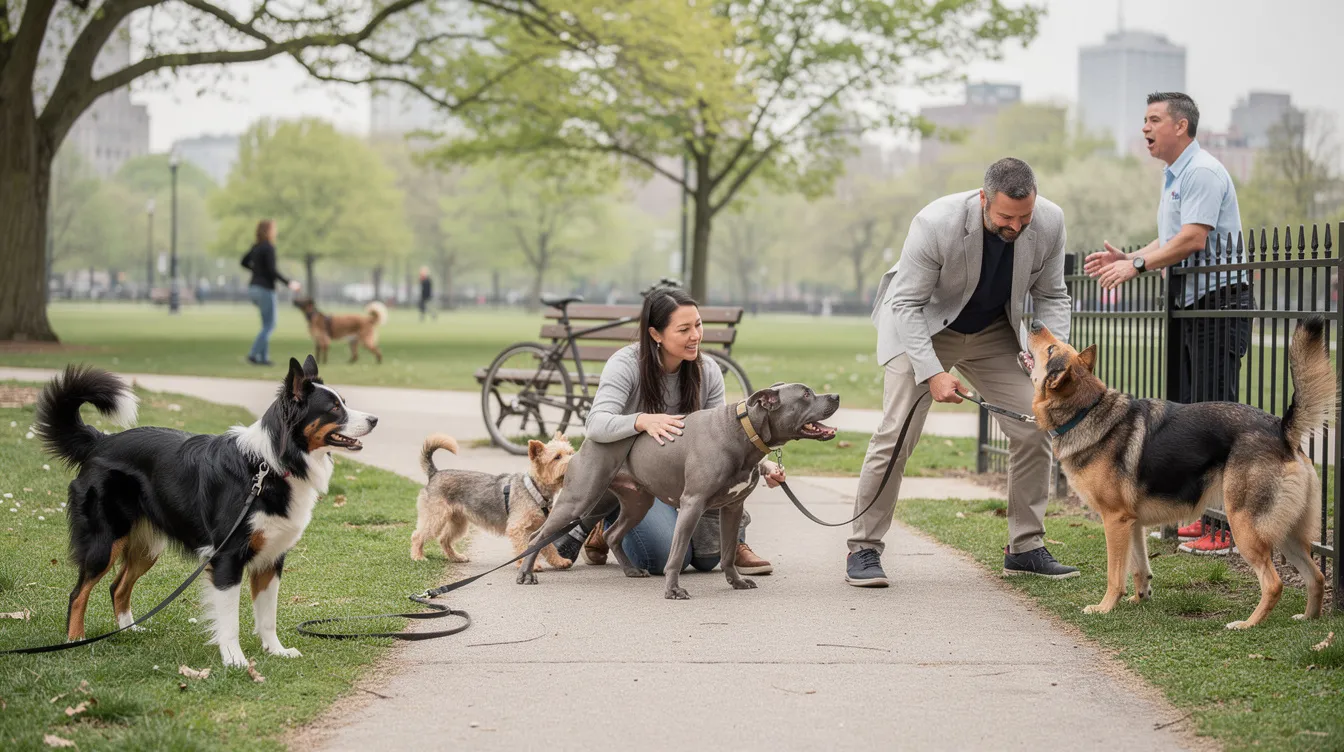
Dog reactivity is an exaggerated emotional response to specific triggers, where a dog reacts with barking, lunging, growling, or freezing at a level of intensity that goes well beyond normal dog behavior. There are multiple distinct types of reactivity in dogs, each driven by different emotional states and triggered by different situations. Identifying which type your own dog displays is the first step toward building a training plan that works.
This guide covers the seven main categories of dog reactivity: leash reactivity, barrier reactivity, car reactivity, dog-to-dog reactivity, stranger reactivity, sound sensitivity, and territorial reactivity. It is written for dog owners in Colorado who are dealing with reactive behavior and need clear guidance on what they’re seeing and when to seek professional help. Topics like general obedience or breed selection fall outside this scope.
The main types of dog reactivity include leash reactivity, barrier reactivity, car reactivity, dog-to-dog reactivity, stranger/people reactivity, sound sensitivity, resource guarding reactivity, and territorial reactivity. Each stems from a different combination of fear, frustration, or arousal, and each requires a different approach to behavior modification.
By the end of this article, you will be able to:
- Identify your dog’s specific reactivity type based on observable behavioral signs
- Understand whether your dog’s reactive behavior is rooted in fear, frustration, or arousal
- Recognize the early signs that reactivity may escalate toward aggressive behavior
- Determine when consistent training at home is sufficient and when professional intervention is necessary
- Connect your dog’s triggers to a structured management and training approach
Understanding Dog Reactivity Fundamentals
Reactivity in dogs refers to observable behaviors such as barking, lunging, raised hackles, rigid posturing, or intense staring that exceed what a situation warrants. A University of Lincoln study surveyed 1,360 dog owners and defined reactivity based on nine distinct behaviors, ranging from mild frustration signals to oral attack. Common signs of reactivity include barking, lunging, and freezing. The key distinction: reactive behavior can differ from aggression because it stems from other emotional states, including fear, frustration, and overexcitement, rather than intent to harm.
Normal alertness involves calm, attentive interest in a stimulus. A dog that notices a passing dog, watches briefly, and returns to walking is alert. A reactive dog staring with a stiff body, barking, or lunging at the sight of another dog has crossed into a heightened emotional state where the dog’s brain is flooded with stress hormones and the dog struggles to return to calm after a trigger is removed. Reactive dogs often struggle to return to calm after a trigger is removed. Aggression, by contrast, involves directed intent to cause harm; research into “reactivity with aggressive manifestations” found that fear, chronic pain, and caregiver factors correlate with the point where reactivity crosses into aggression.
Identifying patterns of triggers helps in understanding the cause of reactivity. Whether your dog exhibits fear-based cowering or frustration-driven lunging determines which training techniques apply. Using the wrong method (for example, aversive correction on a fearful dog) can worsen the dog’s reactive behavior.
Fear-Based Reactivity
Fear-based reactivity arises when a dog perceives a threat in a situation, object, or individual. Fear can trigger reactive behaviors in dogs. Incomplete socialization can lead to fear-based reactivity; puppies need exposure to various stimuli during their critical development period, and those who miss that window at a young age often develop reactivity to unfamiliar people, animals, or environments. Trauma can increase the likelihood of a dog becoming reactive, and genetics can influence a dog’s likelihood of reactivity as well.
Body language cues such as stiff posture and lip licking indicate stress or anxiety. A fearful dog will typically show wide eyes, flattened ears, tucked tail, trembling, or cowering. Dogs bark, lunge, or snap as a way to create distance from a perceived threat. In the University of Lincoln’s caregiver study, highly fearful dogs were five times more likely to display aggressive manifestations compared to dogs with lower fear scores. Fear-based reactivity often leads to aggression in dogs if the underlying fear goes unaddressed.
Frustration-Based Reactivity
Frustration-based reactivity occurs when dogs are restrained, blocked from reaching a desired goal, or otherwise prevented from executing a behavior they want to perform. The dog may have a positive association with the trigger; for instance, a dog that loves other dogs but lunges and barks when leashed because it cannot reach them. Frustration often leads to reactivity when dogs are restrained. Excitement can cause dogs to react strongly to stimuli, and the line between excited arousal and frustrated reactivity blurs quickly.
Behavioral signs differ from fear-based reactions: instead of retreat and cowering, frustrated dogs show forward movement, whining, spinning, and repetitive barking. Research on extinction-based frustration markers found increased vocalizations, restlessness, and ambulation when expected access was withheld. The distinction matters for training: a fearful dog needs desensitization and positive associations, while a frustrated dog needs impulse control work and structured access to rewards. The University of Lincoln cluster analysis found that frustration, posturing, and oral attack are three separate behavioral components; dogs with high frustration scores do not always escalate into biting.
These two emotional foundations- fear and frustration- express themselves differently depending on where and when the dog encounters its triggers. The next sections break down how specific environments shape each reactive episode.
Location-Based Reactivity Types
The physical environment a dog occupies when encountering a trigger shapes how reactive behavior manifests. A dog that is calm and social when off-leash at a dog park may display reactive behavior the moment a leash, fence, or vehicle removes its ability to approach or retreat. Dogs may react more on-leash than off-leash specifically because restraint eliminates their natural coping strategies: approach, investigate, or leave. Understanding location-based reactivity types helps pet parents and trainers choose the right management strategies.
Leash Reactivity
Leash reactivity is one of the most common forms of dog reactivity. A leash-reactive dog reacts to stimuli (other dogs, joggers, cyclists, a passing dog) with barking, lunging, or whining while on leash but may be calm in the same situation off leash. Leash reactivity often stems from frustration or fear. On leash, a dog cannot retreat from a perceived threat or approach something exciting, leaving the dog’s emotional response trapped with no outlet.
Leash-reactive dogs may bark, lunge, or whine at triggers. Common breeds for leash reactivity include terriers and shepherds, both of which are well-represented in Colorado households. Leash reactivity can be managed with counter-conditioning techniques: pairing the appearance of a trigger with high-value treats so the dog’s association shifts from “threat” to “good things happen.” Dogs need to stay below their reactivity threshold for effective training, which means starting at a distance where the dog notices the trigger without reacting and working there before gradually decreasing the distance.
For Colorado dog owners navigating busy Denver sidewalks or Colorado Springs trail systems, leash reactivity turns daily walks into stressful events for both you and your dog. Front-clip harnesses and head halters provide safer control while training begins.
Barrier Reactivity (Fence/Window)
Barrier reactivity appears when a dog is behind a physical barrier: a fence, window, gate, or door. The dog sees movement on the other side, and the barrier prevents either approach or escape. The result: barking, snarling, lunging at the barrier, and intense posturing. Best Friends Animal Society identifies barrier reactivity as a distinct category because removing the barrier often removes the reactive behavior entirely.
Territorial aspects overlap here; many reactive dogs treat the barrier as a boundary to defend. Motion sensitivity plays a role too: a dog that ignores a stationary person outside the fence may erupt when that person walks past. Management includes covering windows, blocking sightlines, and running counter-conditioning sessions where the dog practices calm behavior while a controlled stimulus moves outside the barrier. Arousal-based reactivity is triggered by high-stress environments, and a dog spending hours watching foot traffic through a front window lives in exactly that kind of environment.
The mechanics resemble leash reactivity (restraint + trigger = overreaction), but the barrier adds visual frustration and territorial motivation that leash situations do not always involve.
Car Reactivity
Dogs contained in vehicles face similar constraints: restricted movement, limited escape options, and visual stimuli passing at close range. A dog reacts to pedestrians, cyclists, or other vehicles through the window with barking, growling, or lunging. The causes mirror barrier and leash reactivity, combining frustration with confinement-related stress.
Car reactivity lacks strong prevalence data in published research, but Colorado families who drive frequently with their dogs (to trailheads, veterinary appointments, or errands) encounter it regularly. Safety becomes a concern when a lunging dog distracts a driver. Crate training inside the vehicle, window covers, and short desensitization sessions in a parked car before progressing to moving drives are practical steps. The dog’s access to visual stimuli through open windows directly correlates with how many reactive outbursts occur during trips.
These location-based types share a common thread: physical restriction amplifies the dog’s emotional response. The next section covers reactivity defined by what the dog reacts to rather than where it happens.
Trigger-Based Reactivity Categories
While location-based reactivity centers on the environment constraining the dog, trigger-based reactivity centers on the specific triggers themselves. A dog may be reactive only toward other dogs, only toward unfamiliar people, or only toward specific sounds. Understanding the specific stimulus helps dog owners tailor desensitization and counter-conditioning to the exact situations that cause their dog’s behavior to break down.
Dog-to-Dog Reactivity
Dog-to-dog reactivity is a reactive response toward other dogs, ranging from hard staring and growling to full lunging and snapping. It often traces to early socialization deficits; insufficient socialization can lead to fear and reactivity in dogs. Socialization helps dogs learn to navigate the world calmly, and early exposure reduces the likelihood of fear-based reactions in dogs. A dog that had limited positive contact with other dogs before 14 weeks of age may treat every unfamiliar dog as a perceived threat.
The University of Lincoln’s cluster analysis of 1,360 dog reactive dogs found four behavioral profiles. About 40% fell into Cluster 1 (low-risk signalers showing moderate frustration and posturing but almost no oral attack). Approximately 32% fell into Cluster 3 (impulsive escalators with moderate frustration, high posturing, and moderate oral attack). The remaining groups included frustrated escalators (18%) and risky rapid escalators (roughly 10%), the latter showing rapid escalation with minimal inhibition. No association was found between cluster membership and the dog’s sex, body size, or neuter status, which indicates developmental history and temperament matter more than demographics.
Many reactive dogs with dog-to-dog issues avoid dog park settings or crowded spaces entirely. For dogs in Cluster 3 or Cluster 4 profiles, board and train programs with structured exposure to other dogs provide the consistent training environment that home-based approaches often lack.
Stranger/People Reactivity
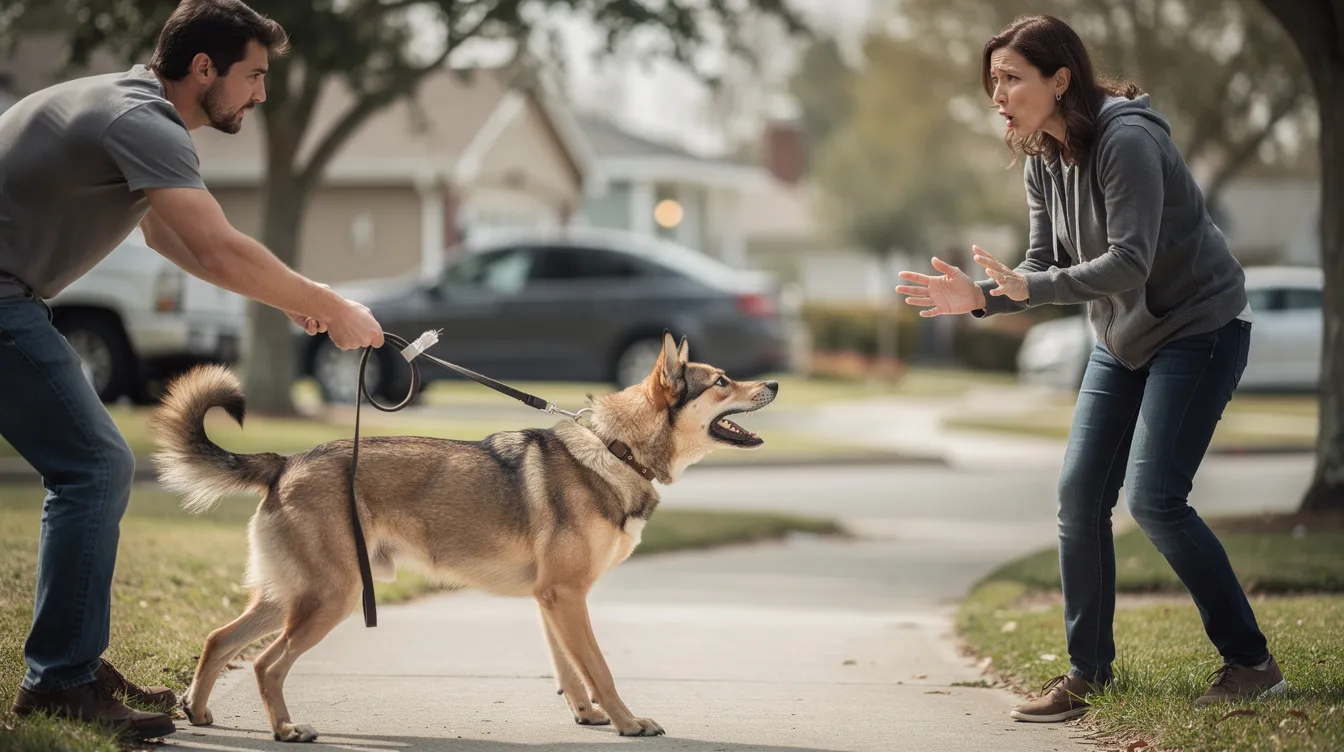
Some dogs display reactive behavior exclusively toward unfamiliar humans. Specific triggers vary: tall men, people wearing hats or uniforms, children, or anyone making sudden movements. Fear or overarousal drives the response, and the dog’s behavior typically includes barking, growling, retreating, or lunging.
Research from the University of Lincoln found that dogs reacting to people or children had approximately 1.7 times the odds of falling into higher-risk behavioral clusters compared to dogs without people-directed reactivity. For Colorado families receiving visitors, delivery drivers, or hosting gatherings, a dog that starts barking and lunging every time the doorbell rings creates genuine safety concerns. Behavior training programs that address stranger reactivity work on threshold management, teaching the dog to hold a “place” command while guests enter, and building positive associations through counter-conditioning pairs triggers with high-value treats to change associations.
Sound Sensitivity
Sound sensitivity is a fear-based reactive response to specific sounds: thunder, fireworks, gunshots, sirens, or construction noise. A survey of 3,284 family dogs found that 39.2% reacted fearfully to at least one loud noise, making this one of the most prevalent forms of reactivity in dogs.
Genetics can influence a dog’s likelihood of reactivity to sound. Herding breeds like Border Collies and Australian Shepherds, both common in Colorado, show elevated noise sensitivity in initial breed-based research. Colorado’s mountain thunderstorm season (May through September) and Fourth of July celebrations make sound sensitivity a recurring issue rather than an isolated event. Sensitization can increase severity over time: a dog that trembles during one thunderstorm may develop full panic responses across subsequent storms if management that prevents dogs from rehearsing reactive behaviors isn’t implemented.
Desensitization involves exposing a dog to a low-intensity trigger gradually; for sound, this means playing recordings at low volume while pairing each session with treats and calm interaction, then gradually increasing the volume across training sessions. White noise machines and safe retreat spaces (interior rooms, covered crates) provide immediate management.
Reactivity Severity Comparison
Not all types of dog reactivity carry the same risk or require the same investment of time and resources. The table below compares the seven main types across three dimensions relevant to Colorado dog owners deciding where to focus their efforts:
| Reactivity Type | Typical Training Timeline | Management Complexity | Professional Help Recommended |
|---|---|---|---|
| Leash Reactivity | 4-12 weeks with consistent training | Moderate (route planning, distance work) | When the dog lunges at every passing dog or person |
| Barrier Reactivity | 2-8 weeks with environmental changes | Low-moderate (window covers, visual blocks) | When the dog damages barriers or self-injures |
| Car Reactivity | 4-10 weeks | Moderate (crate training, window management) | When safety while driving is compromised |
| Dog-to-Dog Reactivity | 8-24 weeks | High (avoiding uncontrolled dog encounters) | When the dog falls into Cluster 3 or 4 profiles |
| Stranger Reactivity | 8-20 weeks | High (managing all human interactions) | When the dog shows defensive aggression toward visitors |
| Sound Sensitivity | 6-16 weeks (longer for severe phobia) | Moderate (safe spaces, sound masking) | When the dog panics, flees, or becomes destructive |
| Resource Guarding | 4-12 weeks | Moderate (structured feeding, trade protocols) | When the dog snaps or bites during guarding episodes |
Dogs with dog-to-dog or stranger reactivity tend to require longer timelines and more controlled exposure environments. Territorial reactivity occurs when a dog protects perceived territory, and its timeline depends on how much environmental modification the owner can implement. For any type, if reactivity can escalate into aggression if not managed properly, professional assessment is the appropriate next step. Most dogs respond to an appropriate training approach when the emotional driver is correctly identified.
Common Challenges and Professional Solutions
Colorado dog owners dealing with reactive dogs face several recurring obstacles. The altitude, outdoor lifestyle, and urban-suburban mix across the Front Range mean frequent encounters with triggers. Here are the three most common sticking points and how to address them.
Multiple Reactivity Types in One Dog
Many reactive dogs display more than one type. A German Shepherd that lunges at other dogs on leash may also bark at strangers through a window and cower during thunderstorms. The Lincoln cluster research showed that dogs reactive to other dogs also showed increased generalization to reacting to strangers, children, and sounds.
The practical approach: prioritize the type that poses the greatest safety risk or most limits the dog’s quality of life. For most dogs, that means addressing dog-to-dog or stranger reactivity before sound sensitivity. Work on one type at a time so the dog’s emotional response to each trigger gets individual attention. Identifying triggers is essential for managing a dog’s reactivity, and keeping a written log of what triggers the dog, where, and how intensely helps a trainer build a targeted training plan.
Escalation to Aggression
Reactivity can escalate into aggression if not managed properly. The warning signs: a dog that was previously a “low-risk signaler” (barking and posturing) begins showing oral attack behaviors like snapping, biting at air, or making contact. Pain-related reactivity may arise from physical discomfort; arthritic or musculoskeletal conditions lower the threshold for aggressive reactivity. A dog in chronic pain may snap at a stimulus it previously only barked at.
If your dog exhibits escalating posturing combined with snapping or biting, take immediate steps: create distance from all known triggers, use management tools (muzzle training, leash control, environmental barriers), and contact a veterinary behaviorist or qualified professional. Caregiver factors matter too; increased caregiver anxiety or depression correlates with more frequent reactive and aggressive displays in dogs, which means managing your own stress response around your dog’s reactivity is part of the solution.
Failed DIY Training Attempts
The most common mistakes when addressing reactivity without professional guidance: exposing the dog to triggers above its threshold (“flooding”), using punishment-based methods on fear-based reactivity (which increases fear), and inconsistent application of techniques across family members. Poor training that relies on corrections without addressing the dog’s emotional state teaches the dog to suppress warning signals, making the dog less predictable rather than less reactive.
Counter-conditioning pairs triggers with high-value treats to change associations, but timing must be precise: the reward must arrive within seconds of the dog noticing the trigger and before the stress response kicks in. Desensitization involves exposing a dog to a low-intensity trigger gradually, but “low intensity” varies per dog, and misjudging the threshold sets training back. Positive reinforcement and reward-calm-behavior approaches require training consistency across every person who handles the dog. Private dog training sessions give owners hands-on coaching in these timing-critical skills that articles and videos cannot replicate.
Conclusion and Next Steps
Each type of dog reactivity- leash, barrier, car, dog-to-dog, stranger, sound, resource guarding, and territorial- stems from a specific emotional driver and responds to a specific training approach. A fearful dog needs gradual desensitization and positive associations. A frustrated dog needs impulse control and structured access. Identifying which type your dog exhibits determines whether training sessions should focus on distance work, environmental modification, sound protocols, or social exposure.
Start with three concrete actions:
- Document your dog’s triggers. For one week, record every reactive episode: what the trigger was, where it happened, the distance at which the dog starts reacting, and how long recovery took. Identifying patterns of triggers helps in understanding the cause of reactivity.
- Reduce trigger exposure immediately. Management prevents dogs from rehearsing reactive behaviors. Change walking routes, cover windows, avoid crowded spaces, and use tools like front-clip harnesses during the documentation period. Positive socialization experiences build trust between dogs and owners, but uncontrolled exposure undermines that trust.
- Schedule a professional evaluation. Off-Leash K9 Training Colorado offers free consultations where a trainer can assess your dog’s reactivity type, cluster profile, and the appropriate training intensity. For dogs in higher-risk categories, a 2-week board and train program provides the immersive, controlled environment where behavior modification can progress daily under professional supervision.
For dog owners whose dogs have not yet developed reactivity, early socialization during the critical 3-to-14-week window is the single most effective preventive measure. Early exposure reduces the likelihood of fear-based reactions in dogs, and structured puppy training programs give young dogs the foundation to handle the stimuli they will encounter throughout their lives in Colorado.