

Off-leash training is the process of teaching your dog to respond reliably without continuous physical guidance. It involves clear communication, consistent practice, and trust between you and your pet. Whether your dog pulls during walks, ignores you when a squirrel appears, or struggles to focus around other dogs, this guide provides a systematic approach to building stronger off-leash skills.
This guide covers everything from foundational recall work to advanced off-leash practice in legally permitted environments. It is designed for dog owners dealing with pulling, poor recall, reactivity, or other behavior concerns, whether they are working with a puppy or an adult dog. The approach includes positive reinforcement, long-line progressions, environmental management, and careful consideration of any specialized training equipment. Advanced aggression rehabilitation and breed-specific medical concerns fall outside this article’s scope.
The direct answer: Learning how to train a dog off-leash begins with dependable recall and obedience in a low-distraction indoor environment. Training then progresses to a securely fenced area, controlled outdoor practice with a long line, and supervised work in legally designated off-leash spaces. Reliability develops through positive reinforcement, consistent practice, gradual exposure to distractions, and responsible management.
By the end of this guide, you will understand how to:
- Build a dependable recall response around gradually increasing distractions
- Create safer off-leash experiences in legally permitted environments
- Develop stronger communication and trust with your dog
- Improve control around pulling, bolting, and everyday distractions
- Maintain obedience skills through consistent, lifelong practice
Understanding Off-Leash Training Fundamentals
Off-leash training means building a high level of dependable obedience without relying on a physical leash for every cue. The goal is not simply removing the leash. It is helping your dog stay close, respond promptly when called, and disengage from manageable distractions.
Even a well-trained dog is not completely predictable. Wildlife, traffic, unfamiliar dogs, sudden noises, and changes in the environment can affect behavior. Responsible handling, legal compliance, and careful environmental assessment remain necessary at every stage.
Foundation Skills Required
Before beginning off-leash work, basic commands should be dependable. Your dog needs consistent responses to cues such as sit, stay, heel, place, and come while on-leash before you can reasonably expect those behaviors without one.
Dog obedience training in Denver can help establish this framework. A dog that can maintain a stay, walk without pulling, return when called, and disengage from manageable distractions is better prepared for gradual off-leash progression. Moving ahead before these skills are dependable can cause recall to break down in real-world situations.
A study involving 364 dog owners by Hiby, Rooney, and Bradshaw found an association between reward-based training and higher owner-reported obedience ratings. The study also found an association between punishment-based training and reported behavior concerns. Because this was an observational survey, it identified correlations rather than proving direct cause and effect. You can review the dog-training-method study here.
Safety vs. Freedom Balance
There is an important distinction between controlled off-leash environments and unrestricted freedom. A securely fenced private yard with familiar distractions is a controlled environment. A crowded dog park with unfamiliar dogs, children, and unpredictable activity is not.
Evaluate your dog’s skills before removing the leash. This is not a matter of confidence alone. It requires an honest assessment of your dog’s recall, temperament, prey drive, reactivity, health, and ability to remain focused.
Dependable recall may help reduce risk during an unexpected situation, but it does not guarantee that a dog will stop before reaching traffic, wildlife, or another hazard. Training must be developed through graduated exposure and responsible management.
In Denver, dogs generally must remain leashed in public unless they are inside a designated off-leash area. Initial off-leash practice should therefore occur only in a securely enclosed private space or an approved off-leash area. Denver’s official dog park rules also require handlers to keep dogs under control and within view.
With these fundamentals understood, the next step is building the specific commands that support off-leash reliability.

Essential Commands for Off-Leash Success
The foundational skills above give your dog impulse control and attention. Three categories of commands can support an off-leash training program: recall, emergency-stop, and place or boundary work.
Recall Command Mastery
Recall is one of the most important skills in off-leash dog training. Your dog should respond consistently in multiple controlled environments before you consider removing the leash in a legally approved area.
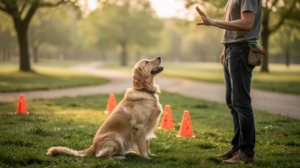
Start recall training indoors in a low-distraction environment where success is likely. Say your cue word, such as “come” or “here,” once. Mark and reward your dog as soon as they move toward you. Use an appropriate reward your dog values, such as a dog-safe treat, praise, play, or a favorite toy, and deliver it promptly after the correct response.
Avoid punishing your dog after they respond to the recall cue, even if they were slow to return. Repeatedly calling your dog only when an enjoyable activity is ending can also make recall less rewarding. Practice calling your dog, rewarding the response, and occasionally releasing them back to an approved activity.
Practice recall in a securely fenced yard before gradually increasing distance and distractions. AKC off-leash guidance recommends using a long line as an intermediate step. A long line gives your dog more room to move while allowing you to maintain physical control.
Introduce distractions gradually rather than surrounding your dog with other dogs, wildlife, or heavy activity immediately. Work far enough from each distraction that your dog can still notice it and respond to you.
Emergency-Stop Command
An emergency-stop cue is intended to interrupt movement and ask the dog to remain in place. This differs from recall because the dog is asked to stop rather than return directly to the handler.
Teach the cue by practicing “stop” or “wait” during controlled movement. Mark and reward the moment your dog stops. Gradually introduce the cue during games and structured activities in a securely enclosed area.
Once your dog stops, you can issue a recall cue or walk to them. Recall and emergency-stop cues provide separate ways to direct movement, but neither should be treated as a guaranteed way to stop a dog that is already chasing wildlife or approaching traffic.
Boundary and Place Commands
Place and boundary commands teach your dog to pause or remain in a clearly designated location until released. “Place” sends the dog to a specific spot, such as a mat, bed, or platform, and asks them to remain there.
This skill can be useful at doorways, gates, car exits, and other locations where you need your dog to wait before moving forward.
For boundary work, teach your dog to pause at clearly defined locations such as a doorway, gate, curb, or campsite boundary. Begin with a visible marker and practice using a standard leash or long line in a legally permitted area. Reward your dog for stopping or returning to you.
A trained boundary should not replace secure fencing, a physical leash, or active supervision. Every family member should also use the same cue words, release cues, and expectations.
Step-by-Step Off-Leash Training Process
The progression from on-leash to off-leash work should increase environmental complexity gradually while giving your dog frequent opportunities to succeed. Moving forward too quickly can cause recall and other obedience skills to break down.
Phase-by-Phase Training Method
- Indoor training with minimal distractions. Practice recall, sit, stay, and place inside your home. Use treats, praise, play, or toys as rewards. If additional guidance is needed, use a standard leash or supervised lightweight training line that cannot become caught on furniture.
- Fenced-area practice with moderate distractions. Move to a securely fenced private yard or enclosed training space. Birds, sounds, movement, and smells provide natural distractions. Use a long line when needed and gradually increase the distance between you and your dog. Reward voluntary check-ins so your dog develops the habit of paying attention to your location.
- Long-line training in controlled outdoor spaces. Use a long line in an appropriate location where its length is permitted and where it will not endanger other people or animals. A well-fitted harness can help reduce pressure on the neck if the dog reaches the end of the line. Do not wrap the line around your hand, and avoid crowded areas where it could become tangled. Practice at a safe distance from dogs, joggers, and wildlife while gradually increasing distraction levels.
- Supervised off-leash practice in securely enclosed areas. Supervised off-leash practice in securely enclosed areas. Transition to off-leash work only in a secure private enclosure or designated off-leash area where dogs are legally permitted. Choose a quiet time and avoid crowded dog parks or unfamiliar dogs during initial practice. Test recall, emergency-stop, and boundary cues while keeping sessions short, positive, and closely supervised.
- Advanced practice in legally permitted environments. More challenging environments may include larger enclosed fields or designated off-leash areas with additional distractions. Continue practicing recall and check-ins without assuming that previous success guarantees future responses. Your dog should wear readable identification and have current microchip information. A GPS tracker may help locate a lost dog, but it cannot prevent an escape or injury.
Training Tools Comparison
| Criterion | Standard Leash | Long Line | E-Collar |
| Primary use | Foundational obedience and close-range control | Gradual distance training while maintaining physical control | Delivers a remote electronic stimulus but provides no physical restraint |
| Training role | Everyday management and foundational practice | Transitional recall and distance work | Specialized equipment used in some training programs |
| Evidence | Appropriate for managing and teaching on-leash behavior | Commonly recommended for controlled recall practice | A cited study found no recall advantage over reward-focused training |
| Safety considerations | Must be fitted and handled correctly | Can tangle or cause injury if handled incorrectly | Carries welfare and misuse concerns and cannot stop a dog physically |
| Important limitation | Limited to the length of the leash | Must comply with local rules and environmental conditions | Not a substitute for a leash, secure containment, or legal compliance |
For most owners, a standard leash and long line provide a practical progression from foundational training to controlled distance work. Positive reinforcement, clear cues, and environmental management should remain central throughout the process.
A controlled study involving 63 dogs found that reward-focused training produced better responses to “come” and “sit” than the e-collar group during the study period. The American Veterinary Society of Animal Behavior also recommends reward-based training and advises against aversive training methods.
E-collars should not be described as a guaranteed safety tool because they provide no physical restraint. Anyone considering specialized training equipment should understand its risks and limitations and seek qualified professional guidance. Dog owners can also review the company’s perspective on e-collar training.
Common Challenges and Solutions
Even with a systematic approach, off-leash training presents predictable obstacles. Knowing how to address them can help keep your training on track and your dog safer.
Dog Ignores Recall Around Distractions
When a dog ignores recall around distractions, the dog may have been advanced too quickly or may be too close to a trigger to respond effectively.
Return to the last environment where recall was dependable and introduce distractions more gradually. Increase distance from the distraction, use a long line, and choose a reward your dog values. If your dog cannot respond, create more distance instead of repeatedly saying the cue.
The study involving 63 dogs with known off-leash behavior problems found that the reward-focused group achieved better responses to “come” and “sit” during up to 150 minutes of training over five days. This result applies to that specific study and should not be interpreted as a guarantee for every dog. Effective off-leash training requires dependable recall, impulse control, and repeated practice in different environments.
Inconsistent Response to Commands
When a dog responds to one family member but not another, differences in cues, timing, reinforcement, and previous training history may be contributing factors.
Every person in the household should use the same commands and release cues. Keep a simple training log so everyone knows which skills were practiced and how they were reinforced. If your dog responds well to one person but ignores another, that person may need to rebuild the behavior through clear cues, patience, and consistent reinforcement.
Private dog training in Denver can give family members personalized instruction and help identify inconsistencies in handling.
Dog Bolts When Off-Leash
Bolting is a serious safety concern and a sign that the dog is not ready for uncontrolled off-leash access. Return to long-line work and avoid removing the leash outside a secure enclosure until responses are more dependable.
Practice a separate emergency recall cue with a highly valued reward reserved for that behavior. Manage the environment by avoiding areas with heavy wildlife, traffic, or unfamiliar off-leash dogs.
Do not assume that off-leash access alone will strengthen trust or resolve bolting. Trust and reliability develop through consistent training, appropriate reinforcement, management, and realistic expectations.
Dog Becomes Overexcited Off-Leash
Structured exercise, sniffing, and appropriate exploration can provide physical activity and mental enrichment for many dogs. These activities may support calmer behavior as part of a balanced routine, but they do not independently resolve excessive barking, mouthing, hyperactivity, or separation anxiety.
Persistent or severe behavior concerns may require an individualized assessment. Owners can learn more about dog behavior training in Denver or consult a veterinarian when a medical or clinical behavior problem may be involved.
Conclusion and Next Steps
Off-leash training is not a single event. It is a gradual progression from foundational commands in a controlled environment to more dependable responses around real-world distractions.
The process begins with indoor recall practice, followed by securely fenced-area work, long-line proofing, and supervised sessions in legally designated off-leash spaces. Every stage builds on the previous one, and continued owner practice remains necessary.
Here is what to do next:
- Assess your dog’s current obedience. Consider whether your dog can maintain a stay, walk without pulling, return when called, and disengage from manageable distractions.
- Schedule a free consultation with Off Leash K9 Training Colorado to discuss your dog’s behavior, training history, and readiness for more advanced work.
- Begin indoor recall practice. Use appropriate high-value rewards, keep sessions short, and avoid punishing your dog after they return.
- Explore the 2-Week Board and Train program. The current Denver program includes advanced off-leash skills, a two-hour owner education session, and free lifetime refresher training. Ongoing reliability still depends on the dog, the environment, and the owner’s consistent follow-through.
For dogs with aggression, severe reactivity, or other complex concerns, explore aggressive dog training in Denver. These services may help owners improve control and management, but no training program should promise that serious aggression will be completely eliminated.
For younger dogs, early puppy training in Denver can help establish foundational commands, confidence, household routines, and age-appropriate socialization.
Frequently Asked Questions
How do I start to train my dog to walk without a leash?
Begin by teaching foundational cues such as sit, stay, heel, and come in a low-distraction indoor environment. Gradually practice with a long line in a securely fenced or legally permitted area. Progress to off-leash practice only after your dog responds consistently and only where local rules allow it.
What if my dog gets distracted and does not come when called?
Return to an environment where your dog can respond consistently. Increase distance from the distraction, use a long line, and reinforce successful responses with an appropriate high-value reward. Avoid repeating the recall cue when your dog is too distracted to respond.
Is off-leash training safe for all dogs?
Off-leash activity is not appropriate for every dog or every environment. Consider your dog’s recall, health, temperament, prey drive, reactivity, and comfort around unfamiliar dogs and people. Practice only in secure or designated off-leash areas where it is legal.
How can I keep my dog healthy during off-leash training?
Provide water, rest breaks, and exercise appropriate for your dog’s age, health, breed, and conditioning. Monitor for fatigue, overheating, limping, or discomfort, and inspect the environment for hazards. Ask your veterinarian about exercise limitations if your dog has an existing medical condition.
Can I teach my dog to walk off leash without professional help?
Some owners can develop these skills through patient, structured practice. Professional guidance may be helpful for identifying training gaps, improving handling techniques, and addressing problems such as bolting, reactivity, or inconsistent recall. No trainer or training tool can remove every risk associated with off-leash activity.