
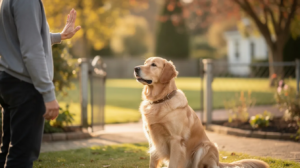
Teaching a dog to stay is one of the most valuable obedience skills you can build, and one that many dog owners find surprisingly challenging. The stay command asks your dog to hold a specific position until you give a release word, supporting impulse control, safety, and real-world manners. Whether you have a puppy who bolts for the door every time it opens or an adult dog who will not settle during dinner, a rock-solid stay can improve daily life with your dog.
This guide covers everything from foundational concepts to advanced real-world proofing. It walks you through session-by-session progression, troubleshooting common problems, and building more reliable behavior outside your living room. Complex concerns such as severe anxiety, fear, or aggression-related behavior may require veterinary assessment and guidance from a qualified behavior professional.
The direct answer: Teaching a dog to stay involves starting in a comfortable position, such as sit or down, rewarding the dog for remaining there briefly, and using a consistent release word to end the exercise. Gradually work on duration, distance, and distractions, often called the “three Ds.” Increase only one difficulty at a time and temporarily lower the other expectations whenever you introduce a new challenge.
By the end of this guide, you will:
- Understand the difference between “stay” and “wait”
- Know how to teach your dog to stay using a structured method
- Be able to troubleshoot when your dog breaks position
- Have a plan for practicing stay in real-world situations
- Recognize when professional training support may be helpful
Understanding the Stay Command
The stay cue means your dog remains in a specific position, such as sit, down, or stand, until you return or give a release cue. It is not a suggestion or a momentary pause. Understanding the criteria before beginning helps you structure each session clearly and consistently.
Stay vs. Wait: Key Differences
Many trainers use “stay” to mean that the dog should hold a specific position until the handler returns or gives a release cue. They use “wait” for a temporary pause before the dog receives another instruction, such as at a doorway, curb, food bowl, or crate.
These definitions are training conventions rather than universal rules. The exact words do not matter as long as each cue has clear criteria and is used consistently. The Cornell University College of Veterinary Medicine recommends using separate cues when owners want to distinguish a formal position hold from a shorter pause.
Using different cues can make expectations clearer. If “stay” means holding a position until you return and “wait” means pausing for the next instruction, every household member should use those definitions consistently.
The Importance of Release Words
A release word signals when your dog can move again. Without one, the stay has no clear endpoint, and your dog may be left guessing when the exercise is over. Common release words include “okay,” “break,” and “free.”
The AKC stay-training guide recommends establishing the release cue early, then gradually building the stay’s duration. Pair the release word with movement so your dog learns that the cue means they are free to leave the position.
Use the release word consistently across all sessions. An upbeat tone can contrast with the calm delivery used during the stay. Because “okay” appears frequently in everyday speech, some trainers choose a less common word such as “free” or “break” to reduce accidental releases.
Essential Training Preparation and Setup
Before you begin training the stay command, having suitable rewards, a manageable environment, and at least one established position cue can prevent frustration for you and your dog.
Required Training Tools
Keep your setup simple. You may need:
- Training treats: Use small, dog-appropriate treats that your dog can eat quickly. Choose a reward your dog values and account for training treats in their daily food intake.
- Clicker or marker word: A clicker or consistent verbal marker such as “yes” can identify the moment your dog is holding the correct position. If your dog treats the click as permission to move, use a verbal marker or repeat the stay cue after rewarding.
- Dog mat or designated spot: A mat provides a visual boundary and may help dogs that tend to creep forward.
- Leash or long line: A standard leash can provide additional control during early practice. A long line may be useful when gradually adding outdoor distance. Attach it to properly fitted equipment, hold it rather than wrapping it around your hand, and supervise your dog directly.
Choosing the Right Training Environment
Dogs should begin learning stay in a quiet environment with minimal distractions. Choose a room away from heavy foot traffic, active windows, and other pets. Use a comfortable floor surface where your dog can sit or lie down safely.
Dogs do not always apply a learned cue automatically in a new setting. A stay practiced in the living room may become more difficult in the yard, at a park, or around unfamiliar people.
Start in a controlled environment, then deliberately practice in different locations while temporarily reducing duration, distance, and distractions. Treat each new environment as an increase in difficulty and make success easier at first.
Prerequisite Skills Assessment
Your dog should understand at least one stationary position, such as sit or down, before you add a stay cue. A down position may be comfortable for longer repetitions, while some dogs initially find a sit easier.
Begin with the position your dog can perform comfortably and consistently. Down is not a mandatory prerequisite for learning stay.
If your dog does not yet understand sit or down, teach one of those behaviors first through short, reward-based sessions. A dog with an established obedience foundation may find the early stages easier.
Step-by-Step Training Method
The three “Ds” of stay training are duration, distance, and distraction. Begin by building a brief duration, then introduce small amounts of distance and distraction separately.
There is no universal number of seconds that every dog must reach before progressing. Increase only one variable at a time, and reduce the other expectations whenever the exercise becomes more difficult.
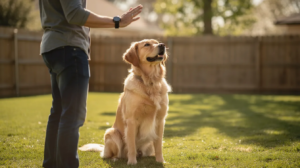
A simple method is to pair a verbal cue with a flat-palm hand signal. A small Journal of Veterinary Behavior study involving nine dogs found no statistically significant reliability differences between vocal-only, gesture-only, and combined cues. Combined cues appeared to require fewer trials in some generalization conditions, suggesting they may be useful, but the small study does not establish that this approach will work better for every dog.
Keep sessions brief enough that your dog remains comfortable and engaged. A few minutes may be appropriate for many dogs, but the ideal length varies by age, health, experience, and motivation. End before your dog becomes tired, frustrated, or repeatedly breaks position.
Foundation Sessions (Sessions 1–4): Building Duration
Start small. The initial goal is for your dog to hold a comfortable position for progressively longer periods while you remain nearby.
- Session 1: Ask your dog to sit or lie down. Say “stay” while showing the flat-palm signal. Wait one or two seconds, mark and reward while your dog is still in position, then give the release word. Repeat several manageable times.
- Session 2: Use the same setup and gradually extend the hold by a few seconds. If your dog breaks position, reset without punishment and try again with a shorter duration.
- Session 3: Continue building duration while varying the exact reward timing slightly. Reward while your dog remains in position and release before they become restless.
- Session 4: Gradually work toward a stay of several seconds. Once your dog can hold that duration consistently, you may introduce one small step of distance while temporarily reducing the duration.
Reward successful repetitions. Praise calmly during the stay and deliver the reward while your dog remains in position, not after they get up. The release word, rather than the reward itself, should tell your dog when they may move.
Adding Distance (Sessions 5–7)
Add a small amount of distance after your dog can hold a brief stay consistently while you remain close. Start with one small step and immediately return.
Some training plans build approximately 30 seconds of duration before adding distance, while others introduce tiny amounts of distance earlier. Follow your dog’s response rather than treating 30 seconds as a mandatory threshold.
- Session 5: Cue your dog to stay, take one small step back, immediately return, reward, and release. Repeat until your dog remains comfortable.
- Session 6: Increase to two or three steps only after the previous distance is consistently successful. Pause briefly, return, and reward. Reduce the distance if your dog gets up.
- Session 7: Gradually vary your movement. Step to the side, shift your body position, or briefly turn away before returning. Introduce only one new movement at a time.
Return to your dog before releasing during early distance training. Calling your dog to you changes the exercise into a recall and can make the stay criteria less clear.
Real-World Application Training
Once your dog can hold a stay consistently in a quiet environment, begin practicing during manageable household situations.
- Practice while walking a short distance toward a kitchen counter.
- Ask for a brief stay while you sit at the dining table.
- Practice during activities such as folding laundry or moving around the room.
- Introduce mild distractions, such as a television playing, another person walking nearby, or a toy resting on the floor.
When introducing a distraction, reduce duration and distance. A dog that can stay for 30 seconds in a quiet room may initially manage only a few seconds when someone walks past.
Adapt the training plan to your dog. A food-motivated dog may struggle near meals, while a high-energy dog may find movement-based distractions more challenging.
When moving outdoors, begin in a securely fenced space or use a standard leash or supervised long line. Start far enough from wildlife, people, traffic, and other dogs that your dog can still respond. Follow applicable leash laws and do not use the stay cue as a substitute for physical restraint near roads or other hazards.
A well-practiced stay may eventually work while you move near a doorway, while the doorbell rings, or while another dog passes at a manageable distance. Continue using a leash, secure enclosure, or other appropriate safety measure where required.
Even a dependable stay should not replace legal leash compliance, physical restraint near traffic, or active supervision during outdoor activities with your dog.

Common Challenges and Solutions
Even with consistent practice, most dogs encounter predictable challenges during stay training. The solution is usually to lower the difficulty and rebuild the behavior gradually.
Dog Breaks Stay Early
Breaking position usually means the exercise became too difficult, the dog was distracted, or the cue was not yet clear in that setting.
Do not punish your dog. Reset calmly and try again with less duration, less distance, or fewer distractions. The American Veterinary Society of Animal Behavior recommends reward-based training and advises against aversive methods because of their welfare risks.
Regress one step and rebuild gradually. If your dog held for 10 seconds but broke at 12, return to a shorter repetition they can complete successfully. Moving back to an easier step gives your dog another opportunity to practice the correct response.
Dog Will Not Stay When the Owner Moves Away
When you add distance and your dog immediately gets up, you may have moved too far too quickly, or your body language may be encouraging the dog to follow.
Practice smaller movements. Shift your weight, take half a step back, return, and reward. Use a leash held by the handler or work in a secure enclosed area rather than fastening the dog to a fixed object, which can create entanglement or injury risks.
Turn your back briefly, face your dog again, and reward the successful hold. Gradually extend these movements so your dog learns that your movement does not automatically end the exercise.
Dog Gets Distracted Easily
When your dog cannot hold position around a new distraction, lower your duration and distance expectations immediately. Begin with a very brief stay while you remain close, then rebuild gradually.
Introduce different surfaces, sounds, people, and animals separately. Smaller steps and more frequent rewards may be necessary for dogs with high energy, a strong prey drive, or limited training experience.
If your dog continues to struggle despite consistent, carefully managed practice, professional behavior training may help identify gaps in the training plan.
Conclusion and Next Steps
A dependable stay cue is built through patient, systematic practice with duration, distance, and distractions. Many dogs can develop this skill, but progress depends on age, health, temperament, training history, environment, and owner consistency.
A stay can improve everyday control and safety, but it should not be treated as a guaranteed way to stop a dog in every situation.
Start here:
- Begin with brief daily sessions in a comfortable sit or down position.
- Use a consistent verbal cue, hand signal, and release word.
- Add a small amount of distance after your dog can complete a brief stay consistently.
- Introduce one new distraction at a time and reduce other expectations when you do.
Dogs with persistent door dashing, intense reactivity, or difficulty remaining in position despite consistent practice may benefit from individualized professional guidance.
Off-Leash K9 Training Colorado’s 2-Week Board and Train program includes extended sit, down, place, door manners, meal manners, and training around distractions. Program suitability and results vary, and continued owner practice after the handoff remains necessary.
Owners can also request a free consultation to discuss their dog’s training history, current challenges, and possible program options.
Once your dog has a solid stay, useful next skills include recall and heel. Together, these cues can support a broader obedience foundation and more manageable everyday activities. However, trained cues do not remove every risk or replace a leash where one is required.
Frequently Asked Questions
How long does it typically take to teach a dog to stay?
There is no standard timeline for teaching a dependable stay. Some dogs understand the basic exercise within a few sessions, while reliable responses around distance and distractions may take weeks or longer. Progress depends on the dog’s age, health, temperament, training history, and practice environment.
Can I teach a dog to stay without using treats?
Yes. Although treats are effective for many dogs, praise, toys, or play may also be used when the dog values them. Choose a reward that motivates your dog and can be delivered without causing them to break position.
What is an example of a good release word?
Common release words include “okay,” “free,” and “break.” Choose a word you do not use frequently in everyday conversation to reduce accidental releases. Use it consistently to signal that the stay has ended.
How do I get my dog to stay when there are distractions?
Start in a quiet environment and introduce distractions one at a time, reducing duration and distance if your dog struggles. Outdoors, use a standard leash or supervised long line attached to properly fitted equipment. Begin far enough from distractions that your dog can still respond successfully.
Should I start stay training with my dog sitting or lying down?
You can begin with either sit or down. A down position may be more comfortable for longer repetitions, while some dogs initially find sit easier. Use the position your dog already understands and can hold comfortably.
How can I help my dog stay calm during training sessions?
Keep sessions brief and positive, use calm praise, and reward your dog while they remain in position. If your dog breaks the stay, reset without scolding and make the next repetition easier. Consistent criteria and manageable practice can help your dog remain engaged.